
What does it take to get around 30 EV charging professionals to Berlin? In our case, 1,366 kilometres in an electric bus, 27 Wiener schnitzels, 30 litres of water, a pub quiz, 90 beers and an average energy consumption of around 0.72 kWh per kilometre.
Oh, and one coffee machine that refused to give us any coffee!
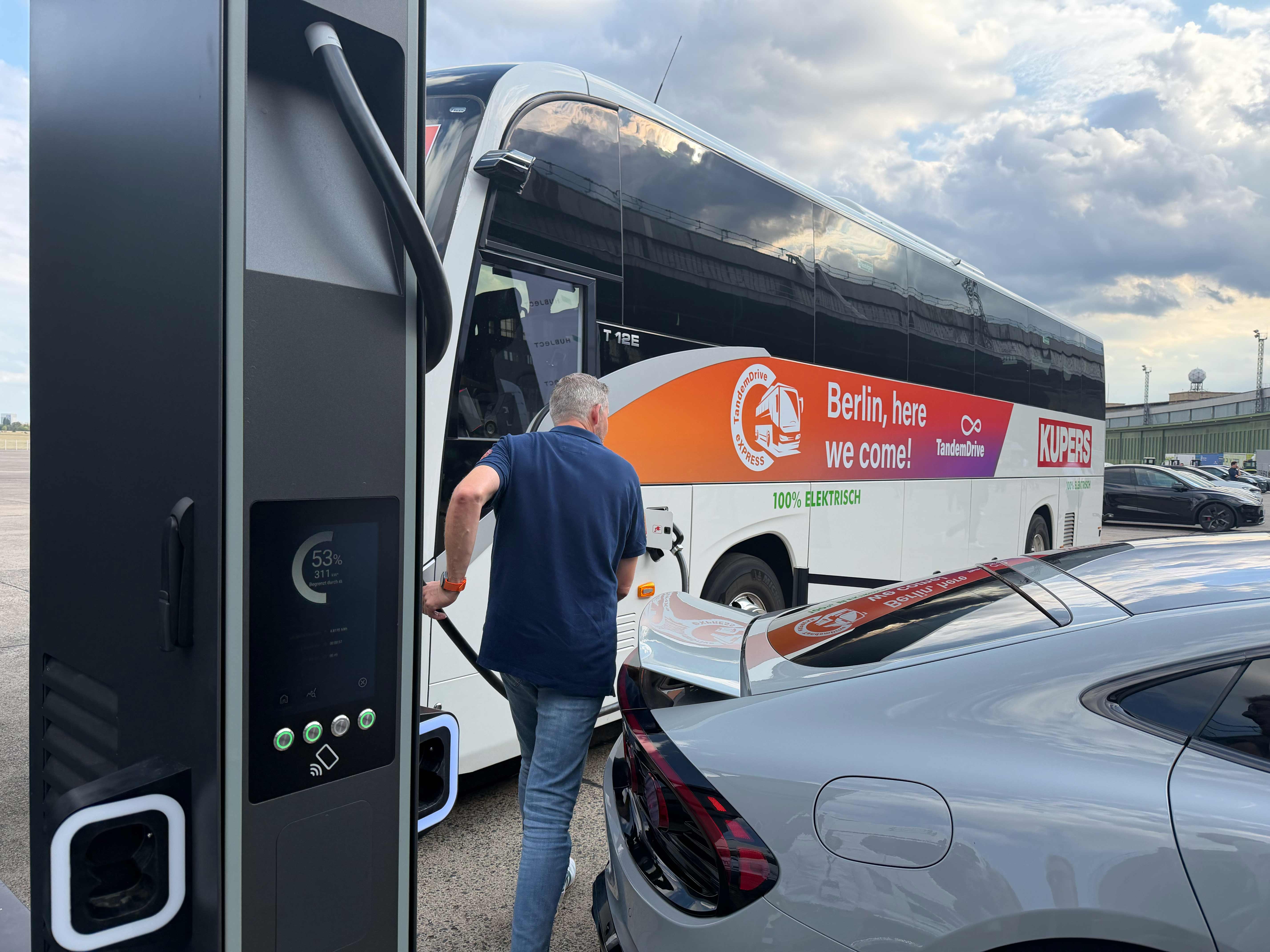
The TandemDrive Express was our way of doing ICNC 2026 a little differently. We brought together people from across the EV charging ecosystem and travelled to Berlin as a group.
After a stop at Milence Barsinghausen, where the bus and the passengers both got a chance to recharge, it was onwards to the event. (Some truly delicious German cuisine was consumed!)
The bus certainly got noticed when it arrived at Tempelhof, and we’re very grateful to Hubject for inviting us to park the TandemDrive Express right at the venue on the airstrip. The attention was welcome, but just as important was the extra time we got to spend together with everyone.
Conferences are great for meeting people, but they aren't always great for actually talking to them. Conversations are squeezed between presentations and meetings, and sometimes you're speaking to someone while simultaneously thinking about where you need to be next. On the TandemDrive Express, nobody was going anywhere. Well, apart from Berlin. That created time for longer conversations, different perspectives and the kind of discussions that rarely happen when you're rushing around an exhibition hall. Several people told us afterwards that the journey itself had been as valuable as the event. We felt much the same.
And for anyone wondering about the practicalities of taking a full-size electric bus that far, the technology wasn't the dramatic part. The journey ran remarkably smoothly and the average energy consumption was lower than we expected. In fact, the data afterwards showed that the outward journey could technically have been completed on a single charge. It would have been close, and stopping was obviously the sensible choice, but it was still an impressive result.
So yes, we successfully transported 30 EV geeks across Germany in an electric coach. What a ride.
TandemDrive Express: the numbers
A big thank you to Kupers Touringcars, and especially our driver Maurice, who got the TandemDrive Express and everyone on board safely to Berlin and back. The return journey alone was almost 780 km, with Maurice spending 9 hours and 35 minutes behind the wheel. That's a serious day's driving.
The EV charging market is growing up
Once we reached ICNC, one thing became increasingly difficult to ignore: the EV charging market is entering a different phase. Consolidation is visible, competition is getting tougher and some companies are disappearing while others fight for scale. Simply having a long list of features is also becoming a much weaker differentiator.
In his keynote, AMPECO CEO and co-founder Orlin Radev summed up the strategic choices facing Europe’s charge point operators particularly well: get big, get niche, or get out.
It’s provocative, but the underlying point is difficult to argue with. As eMobility matures, companies need to become much clearer about where they create genuine value.
We saw that particularly clearly across the CPMS landscape. There are several major players competing hard for position, but many are telling increasingly similar stories: more features, more functionality, more capabilities. The problem is that when everybody has a long feature list, the feature list stops being the interesting part. The more important question is what business problem are you actually solving?
That's the question we believe will matter increasingly over the next few years.
Specialisation isn't the same as being small
This is also why the idea of “going niche” resonated with us, although we'd define it slightly differently. TandemDrive specialises in the operational and financial processes behind EV charging transactions. That might be a specific part of the ecosystem, but the problem itself isn't niche. Virtually every charging business needs to turn charging sessions into accurate financial outcomes.
Every session creates data. CDRs need to arrive, tariffs need to be correct, transactions need to be checked, roaming partners need to be settled and exceptions need to be identified. Ultimately, the right amount of money needs to reach the right place. You can manage much of that manually when volumes are small. You can build spreadsheets, create workarounds and add people as the workload increases.
But that's not scalability.
TandemDrive automates these processes so that increasing transaction volumes don't have to mean increasing manual workloads. The transactions that match expectations can flow through automatically, while the exceptions that genuinely require expertise are brought to the surface. So there’s our niche right there. And as the market becomes more competitive, we believe this kind of specialisation will only become more important.
Growth alone isn't enough anymore; charging businesses need operations capable of supporting that growth efficiently and accurately.
Some “future” conversations have been going on for a long time
There was another side to ICNC that stood out to us. For an industry built around rapid technological change, some conversations are moving surprisingly slowly. ISO 15118 is perhaps the clearest example. Its potential isn't new, yet adoption continues to progress more slowly than many expected. At times, some of the discussions could almost have been taken from presentations several years ago.
Smart charging raises an even bigger question: who is actually in charge? The MSP? The CPO? The grid operator? Another party? There is no shortage of individual initiatives and bilateral discussions, but the industry still lacks enough common ground on how the different players should work together. Too many parties understandably want their own position in the value chain, while the bigger challenge requires cooperation across the ecosystem.
That leads to one of our biggest takeaways from ICNC: new technology is not the same thing as progress. Technology creates progress when it can be implemented, integrated and turned into something that works commercially and operationally at scale. The industry doesn't need innovation simply for the sake of adding another feature. It needs solutions to real problems.
The boring stuff is becoming business-critical
As EV charging matures, some of its least glamorous processes are becoming some of its most important. Financial correctness probably isn't going to attract the biggest crowd at an eMobility conference. Neither are transaction reconciliation, settlement or exception management. But when you're processing hundreds of thousands or millions of charging sessions, these things matter enormously.
A missing CDR can become lost revenue. An incorrect tariff can become a billing problem. A tiny discrepancy multiplied across huge transaction volumes stops being tiny. And a manual process that works perfectly well at 10,000 transactions can become a serious operational bottleneck at one million.
That's why we believe the next phase of EV charging won't only be about installing more chargers or launching more functionality. It will also be about making the machinery behind the industry work better: cleaner data, greater automation, more financial accuracy and less human effort spent checking transactions that were correct in the first place. That's not necessarily the loudest part of eMobility, but it is how you build an industry capable of scaling.
Sometimes you need more time to talk
We left Berlin with plenty to think about. The market is maturing, consolidation will continue and businesses are going to face much more pressure to prove the value they actually create. At the same time, some of the industry's biggest technological ambitions still require much greater alignment between the different parties involved.
But one of our favourite lessons from ICNC happened before we even arrived. The EV charging ecosystem is complicated because so many different businesses, technologies and interests need to work together. That makes opportunities to actually understand each other important. Not another five-minute conversation squeezed between meetings, but enough time to listen, challenge each other's thinking and understand the problems other parts of the ecosystem are trying to solve.
That's what happened on the TandemDrive Express. For a few hours, people from different parts of the ecosystem were simply travelling in the same direction. They made new connections, strengthened existing ones and had conversations that continued long after we arrived in Berlin. For an industry that needs more collaboration, perhaps there was something fitting about that.
The TandemDrive Express got us to ICNC. What we heard on the road and in Berlin made us even more certain about where the industry needs to go next: less complexity, more collaboration and a much sharper focus on real business value.
And if we do it again, there's one improvement already at the top of the list: next time, the coffee machine gets its own pre-departure test.